


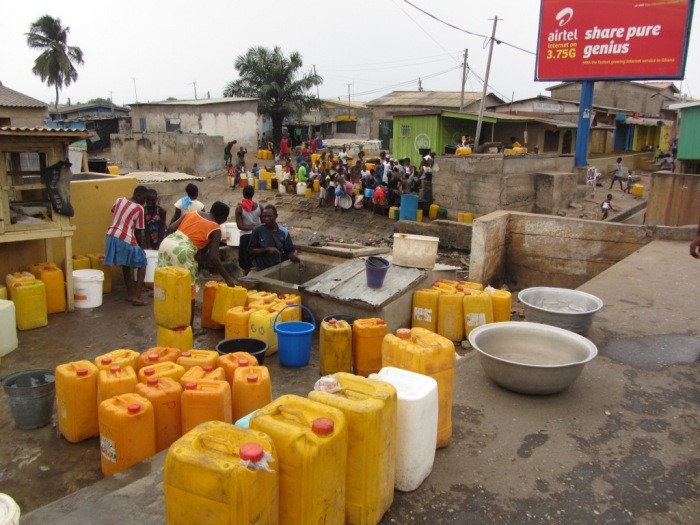
Water and electricity are scarce and cherished commodities in Ghana, and residents in Dunkonah are privileged not to lack the prized service.
For many years, access to quality drinking water and electricity have been a challenge -- especially for people in the country's capital Accra, where attempts to match demand to supply has been hit and miss or largely failed.
Policymakers have already ruled out any strategy that will ensure that Ghana is able to halve the number of people who do not have access to safe drinking water by the 2015 UN deadline. WaterAid, an international charity organisation has reported that about seven million people in Ghana now do not have access to clean water.
Emerging suburbs and urban communities in the country consider access to water and electricity as arguably the two biggest issues that define the pace of development, as people are unwilling to settle in areas where access to utility services are out of reach.
Yet many communities in mainland Accra, particularly, those on the east side of the capital such as Adenta, have lacked access to potable drinking water for many years with no end in sight.
According to the Ghana Statistical Service, access to and use of water is a challenge in urban areas. For instance, 28 percent of households in Greater Accra do not have access to good drinking water, and rural communities continue to rely on unsafe drinking water supply.
While access to electricity is available for about 90 percent of households in the Greater Accra Region, accessibility and availability of water is a big issue, signalling the direction of housing spend.
“For me, access to water and electricity is a basic requirement. There is no way I will live in an area where I can’t get good reliable access to water. All the basic essential services must be available. I know some parts of Accra where people have challenges in the provision of water and electricity,†said Eric Osiakwan, Director of Internet Research Ghana.
Mr. Osiakwan, who is also the Secretary to the Ghana Internet Service Providers Association (GISPA), believes that a community with an airy environment and close to nature makes for ideal living.
As access to essential amenities is beyond the reach of many, residents of Dunkonah have them in abundance. It is most probably the main reason for the rise of the community.
The tranquil and serene environment and the abundance of potable drinking water and electricity in the west end of Accra have pushed Dunkonah to the forefront of the best places to live.
The proximity of Dunkonah to the Weija Dam --- one of the major sources of portable drinking water -- guarantees access and availability of water. The Weija Water Treatment Plant supplies the bulk of water used in Accra.
The Bortianor District office of Electricity Company of Ghana is located in Dunkonah, which is just behind the fast- rising West Hills Mall, ensures that electricity supply is available to the community.
The cluster of educational, entertainment and medical facilities in the area also ensures that residents have access to amenities that improve and define quality of life.
Indeed, Dunkonah personifies the “new Accraâ€. Demand for housing in the area has surged in recent times, and does not show any sign of respite as new estate communities such as Fortune Island come on-stream.
Certainly, economic prospects have opened-up new areas in the capital where the provision of electricity, safe water supply and sewerage, improved housing, and well-planned settlements is challenging the status-quo of urbanisation.
In fact, without a visit to Dunkonah, Accra’s modernity cannot be fully appreciated. And a good way to get an impression of the well-planned developments at the west side of Accra is to take a drive on the world-class George Bush Highway -- otherwise known as the N1 -- to Fortune City, a fully-serviced 150-acre estate development enclave being spearheaded by Sunda (GH) Real Estates Limited.
One thing is that Dunkonah has got all one would want in a place to raise a family: water and power as well as plenty of green space, good schools, and a strong sense of community.
By: Evans Boah-Mensah






Facebook
Twitter
Pinterest
Instagram
Google+
YouTube
LinkedIn
RSS