


By Yao Afra YAO
Chapter 1
A rundown: the rundown world
A whole lot has transpired in the world since we last spoke. Trump says the world’s saving has been left to him—dumped on him… The UN is virtually doing nothing, he insinuates. Eight wars—soon to be nine… Eight whole wars, he has solved so far, he insists. And all the UN has done to assist this ‘saving’ mission has been to get him stuck on a bad escalator and a bad teleprompter—the former impeding his walk, the latter, his talk… [You know what, I admit that this is a very cheesy line but, hell, I’m keeping it]. Unlike the UN and its many institutions, Trump walks his talk on this ‘world saving’ mission—so he says. The United Nations, together with its network of institutions, claiming to preserve global peace and security, is ultimately a useless bunch; and it is the US anchoring us all. Trump has not held back rubbing this narrative in.
Increasingly, the global strides towards sustainability are being rubbished. Bill Gates, a staunch advocate for the green revolution—upon seeing the charts and financial projections as it pertains to the AI revolution, his company—Microsoft’s—partnership with OpenAI, Microsoft’s own long-term ambition of leading the revolution upon its inevitable severance with OpenAI, and the sheer amount of energy (crucially, fossil fuel) needed to drive this AI agenda—has made a shocking, duplicitous 180-degree U-turn. There are more urgent problems for the world to focus its attention on than this matter of climate change, he informs us. And to this, Trump says, kudos! “Climate change is the greatest con-job ever perpetrated on the world!” he proclaims. “I (WE!) just won the War on the Climate Change Hoax. Bill Gates has finally admitted that he was completely WRONG on the issue. It took courage to do so, and for that we are all grateful,” he praises his fellow billionaire, further patting himself on his own back for, among others, pulling the US out of the Paris Agreement. And there goes another blow to the UN, international law, and global governance in general.
Since 2022 and 2023, the Russia/Ukraine and the Israel/Palestine wars respectively have both raged on. The latter is presently tinkering with a very tenuous peace deal, with the agreement’s stipulation of a ceasefire still being ignored by Israel as we speak. Hence, on and on the war goes, with a cumulative death toll of over 70,000—and counting. The Russia/Ukraine peace talks are also at a very precarious stage, with Ukraine insisting on the necessity for the inclusion of robust security guarantees before such a peace deal may be deemed acceptable. Russia, on the other hand, insists, among others, on keeping the good chunk of territories snatched up from Ukraine during the course of the war, particularly in the Donbas region; they also expressly refuse, in perpetuity, Ukraine’s admission into NATO—Russia’s historic and present institutional foe. Because Ukraine’s attempted membership in NATO is one of the factors that triggered Russia’s act of aggression in the first place; how then does Russia accept Ukraine’s acceptance into NATO as a prerequisite security guarantee for the ending of the same war? That is the story according to Putin.
So then, from the 28-point plan put forth by the US (which some believe to have disproportionately favoured Russia) to the counter 19-point plan drawn by the US, Ukraine, and Europe (which, at the time of writing this article, is being deliberated), the Russia/Ukraine war is still blasting on, making a mockery of the concepts of state sovereignty, human rights, and international law—completely laughing in the face of the United Nations, with the big guns (the big nations) instead, ultimately taking charge, and Trump hoping to make this his ‘ninth win’, because—say it with me—he has “stopped eight wars; soon to be nine…!”
Add to this, the International Criminal Court’s arrest warrants for figures like Putin and Netanyahu for international crimes, although still in force, have unsurprisingly continued to be ignored. This is a trend all too familiar to the ICC—an institution created with the very grand aims of putting an end to impunity and grave crimes that threaten global peace and security.
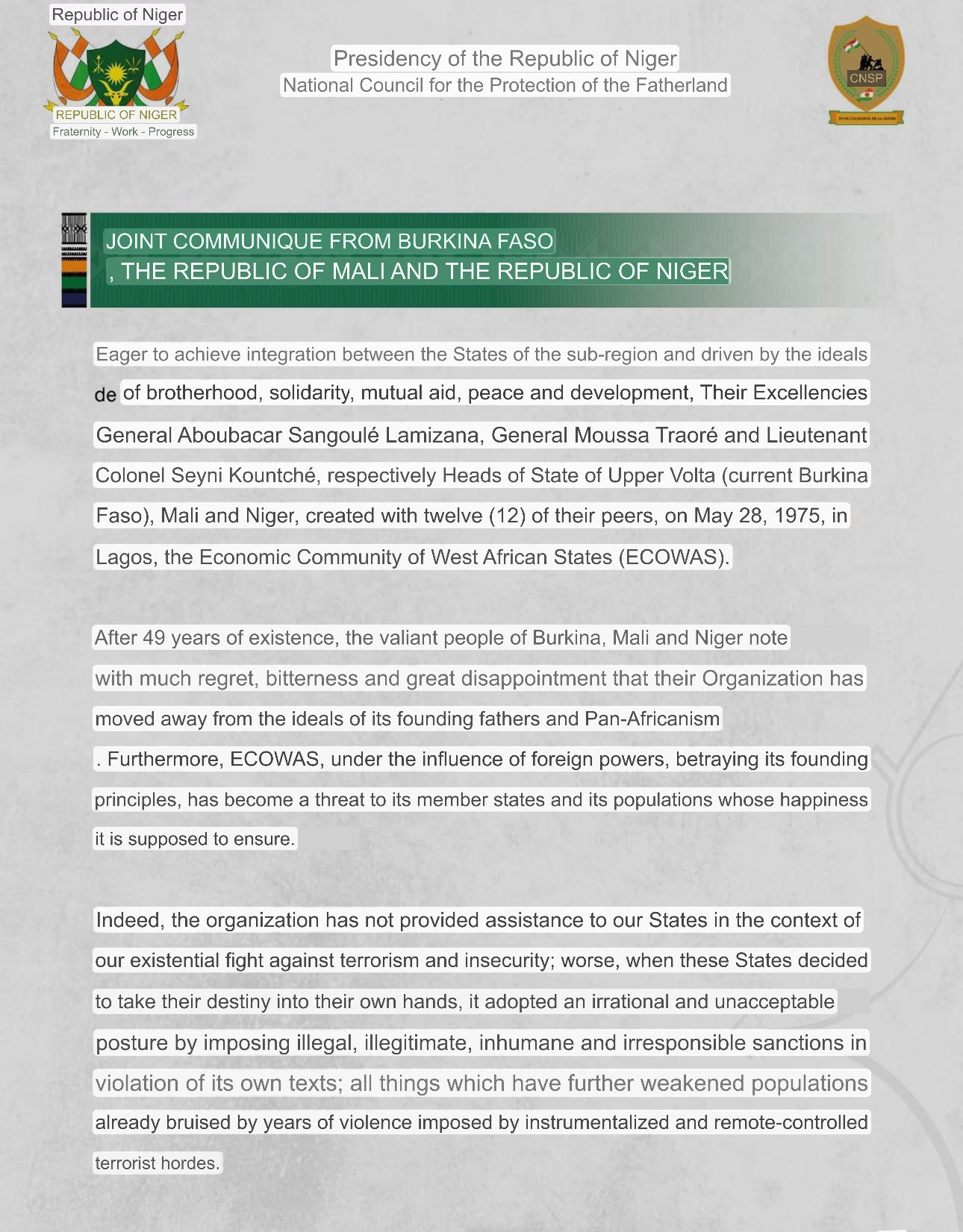
Right here on our beloved continent, notes of unrests have reared their heads—here and there. Our kinsfolk in Rwanda and DR Congo, for instance, let out a week-long scuffle in January this year. This is a recurrent regional friction whose seeds—like many nations of the Global South—were sown by the West as part of its saviour-cosplaying-cum-looting operation of the colonial era. Insurgencies and ensuing conflicts have gripped other parts of the African continent, notably the Sahel region—Ghana’s own neighbour, Burkina Faso for one. In January of this year, Burkina Faso, alongside fellow Sahelian nations of Mali and Niger exited ECOWAS, citing, among others, the organisation’s ineffectiveness at combating terrorism in the region, its unfair sanctions imposed on these three nations after their respective coups, and its subordination to Western influence as causes. Other fellow countries of the Global South like India and Pakistan have experienced similar Western-imperialism-originated-and-recurring conflicts during the course of this same year, with the long-standing struggle over Kashmir causing a four-day clash between these two countries in May. And this is a conflict whose roots are, very regrettably, far from being uprooted with the signing of a ceasefire—as so done on 10th May this year.
While still raining an unyielding assault on Gaza, Israel undertook a quick side quest on Iran, a surprise attack that resulted in a two-week tussle in June this year, an attack actively supported by Israel’s longstanding ‘sidepiece’, the US, and eventually ending with a ceasefire deal—yet another tenuous one.
As the glaring genocide committed by Israel has been actively swept under the carpet by the West, by the US especially—right from the Biden through to the Trump administration—Donald Trump, inspired by his on-again, off-again friend, Elon Musk, put it directly to Ramaphosa and proclaimed boldly to the world not too long ago that White South Africans were under genocidal attack—in the very country over which they (White South Africans) have a socioeconomic chokehold… So, asylum it is—very quick intervention for the fellow White man—always for the fellow White folk!—while millions of Palestinian women, men, and children perish under the ongoing Israel-US-Europe neo-imperialistic campaign.
On international waters, right off the coast of Venezuela, in the Caribbean Sea, the US is presently conducting lethal strikes against boats and submarines purported to be smuggling drugs. Bending international law to its absolute limits and absurdity—very much on brand with the West and the US notably—the Trump administration is putting lipstick on a pig, insistent on painting this barbaric act of theirs as a self-defence act of a sort against an ‘armed attack’ by so-called South American ‘terrorist’ drug cartels. That is to say that this alleged act of smuggling narcotics into the US by South Americans—in the USA’s estimation—qualifies, under international law, as an armed attack—as an act of war. This is absolutely ridiculous—a child’s attempt at interpretation of the law. Yet, here we are. It is the Global North’s world. They bend and break the law as they deem fit while the rest of us sit and watch. Complain, we may; but ultimately, ours has been to sit and watch.
In the UK, we find the otherwise immigration-friendly Labour government almost throwing in the towel on immigrants, notably, refugees. Indeed, the world’s original and foremost ‘border infiltrator’ and ‘forceful migrator’, the United Kingdom, says it is growing tired of the influx of immigrants into its borders. The government has announced an overhaul to its asylum policy with restrictive clauses such as, among others, the reduction of the tenure of protection for refugees from permanent/long-term to temporary protection and the undertaking of periodic reviews every two and a half years to assess the statuses of these refugees to determine whether a return to their home countries is feasible. This reform seeks to limit the interpretation of a regional instrument such as the European Convention on Human Rights (ECHR) on the matter of human rights promotion and protection in the UK. The Conservative Party—its leader, Kemi Badenoch especially—has called for the UK’s withdrawal from the ECHR altogether, viewing this regional institution instituted to promote and protect human rights in the region, as an impediment to the country’s sovereignty and a hurdle to its national policies such as immigration control. Isn’t it just funny whenever nations of the West dare to purport a breach of their sovereignty and rights?!
Long story short: everyone, everywhere is doing whatever they like.
International law and global governance are not having a good time—they are not at their strongest. And this is to just name a few of these instances of international upheavals and disruptions—global and regional. We have not even dealt with the many instances of economic tensions experienced during the course of the year. All around the world there is prevailing, a narrative of ‘you can’t tell us nothing!’ Isolationist impunity and impetuosity run rampant. There is this whole ‘de w’ofiye asem’ campaign going on, with countries across the globe keen on doing as they please to whomever they please on the international plane—expecting and accepting no repercussions from the international systems set up to maintain peace and order.
This, I must note, has been the approach of the West since the dawn of modern history and the creation of these modern systems of international law. However, very slowly but surely, the rest of the world—quite understandably—is catching on in this trend of impunity. Because after all, what does game theory teach us? Everyone acts in their own best interest, knowing that others are also acting in their own best interest. Each one for him/herself—each nation for itself. If the powerful nations will consistently and unapologetically continue to do with the law as they please, bend and break it every chance they get, what is the incentive for the “weaker” countries to obey the rules of the game?
We really seem to be headed for a global jungle—although, again, it can be argued that we in the Global South have, since the institution of the modern systems of international law, had a piece of hell carved out of this system specifically for us. We have always been dealt a bad hand—so there is nothing really new here.
But then, one cannot help but see that there is a conscious effort ongoing towards the dismantling of these international systems. This conscious razing promises no reform at the end—as one would think, but rather, complete anarchy. The United States, with its painstaking attempts at discrediting and bulldozing the United Nations and its network of institutions, is not doing so with the hopes of building a much more equitable international system—as long advocated for by us the people of the Global South; rather it is a painstaking attempt towards completely removing the global community’s veil of multilateralism and, in the face of growing competition from rivals like China, place the USA unapologetically on the throne of global governance—a throne supposed to be occupied by this so-called unbiased institution, the United Nations.
Indeed, we, the people of the Global South, have long fought for the deconstruction—and reconstruction—of international law and its systems to rid it of its Euro-American-centrism. Hence, it is very easy for such mentions of the dismantling of the present system of global governance to excite us. But one must exercise care, and see this wave of dismantling for what it truly is. The West (the US to boot), unlike us, has no reconstruction in mind; rather, a replacement. It seems to be their ultimate goal that the United States (the US) becomes the United Nations (the UN). We will explore this argument of the USA’s feigned desire for isolationism hiding an absolute hegemonic agenda in a later article. For now, let us turn to one of the few countries doing its utmost best to uphold these communal systems of international relations—Ghana. This is not a punchline to a joke, I promise.
Chapter 2
Ghana, Torkornoo, and ECOWAS: Madam Do-the-Right-Thing
Mr. Bernard Bediako Baidoo, MP for Akwatia, says he disagrees with the ECOWAS Court of Justice on, among others, the matter of jurisdiction. Ghana is a sovereign nation, he notes; and we have our Constitution which establishes the Supreme Court as the highest court of the land… “Of course, we have those treaties,” he concedes, interjecting his own argument. But it’s our sovereignty we are talking about here—and, very respectfully, in his personal opinion, national sovereignties are inviolable, not even the ECOWAS Court should be allowed to breach them.
Mr. Baidoo is not alone in this assertion. Some, inspired by politics, others, by an unadulterated appreciation of the law perhaps, make this same argument of the lack of jurisdiction of the ECOWAS Court to hear this case brought before it by the ‘former’ Chief Justice of Ghana, Her Ladyship Gertrude Torkornoo, regarding the alleged breach of her human rights—particularly, her right to a fair hearing. But I must say, I, for one, don’t believe that Mr. Baidoo—being himself a lawyer—necessarily buys his own argument of sovereignty being a roadblock to the jurisdictions of international and regional organisations like the ECOWAS Court—especially when countries are signatories to treaties establishing these organisations.
In a world where emotions seem to be ruling global affairs, national and international discourses and dynamics, it is important that we do the very best we can to consistently bring some levelheadedness to certain crucial issues. So then, sentiments and political leanings aside, let each Ghanaian ask themselves: what is the ECOWAS Court, and can it be legally said to have jurisdiction in this case of Justice Torkornoo? And mind you, whatever response we may find in the law on this question does not necessarily affect the substantive matter at hand—i.e., the allegation of the breach of her human rights.
ECOWAS – on the matter of jurisdiction
By the mid-20th century, a large chunk of the African continent had attained their independence from colonial rule… A reign that involved such mass, morbid human rights abuses on a scale never before seen in modern history, committed by the West upon the continent, had come to an end. The continent was purportedly now free to pursue its own destiny—economic, cultural, social, and political. Being fresh off the boat of colonialism, these newly independent nations were understandably too fatigued. Fragile and weak to survive in a world dominated by the past colonial oppressors, they had to undertake a conscious mobilisation and coalition-building. To completely break free of the influence of imperialism and prosper as independent nations of the highly competitive world, regional integration and cooperation was vital. Thus came the idea for the establishment of pan-Africanist institutions such as the African Union (formerly the Organisation of African Unity) and regional economic communities (RECs) like the ECOWAS (for the West African region), EAC (for the East African region), SADC (for the South African region), etc.
The overarching missions of these regional organisations were simple: help the attainment of economic development for the continent of Africa—an economic prosperity which would culminate in the continent’s positioning as an equal and influential player on the global stage. No sooner had these regional institutions like ECOWAS been established than the realisation hit the continent that economic development, political stability, and human rights were mutually inclusive concepts—one could not be attained without the other. In other words, in order for this continent of Africa and this region of West Africa (in the case of the ECOWAS) to actually attain their mission of economic growth, they had to pay close attention to, among others, the issue of human rights and political stability. So, in 1993, the ECOWAS Treaty of 1975, which had Ghana as one of its fifteen founding nations, was revised, with the mandates of the Community expanded beyond economic matters to include civil and political issues—notably, the promotion and protection of human rights.
So then, this revised Treaty and accompanying Protocols went on to establish the ECOWAS Court of Justice, a court whose jurisdiction, according to Article 9(4) of the Protocol on the Community Court of Justice, as amended by the 2005 Supplementary Protocol, was to include: the determination of cases of “violation of human rights that occur in any Member State.” And according to Article 15(4) of the Revised Treaty, judgments of the Court were to be binding—on Member States, institutions within ECOWAS, individuals and corporate bodies of Member States alike. In fact, with the 2005 Supplementary Protocol, we find the ECOWAS Court being one of the very few courts of its kind—both regional and global—that very explicitly provides ordinary citizens of Member States direct access, with no requirement to exhaust local remedies. That is to say that Justice Torkornoo need not have gone all the way through the Ghanaian judicial system—all the way through to the Supreme Court; she could have even brought the case directly before the ECOWAS Court. Is that a bit much? You tell me. This is a treaty which we, as a country, have expressly agreed to be bound by.
Any argument of the sovereignty of nations as superseding the jurisdiction of such regional and global treaties—which nations, on their own accord, sign on to—as attempted by Mr. Baidoo for instance, presents itself as an existential crisis of a sort. It is one that attempts to shake, not only the foundation and very essence of the ECOWAS Court, but also international law as a whole. Because the concepts of international law and absolute sovereignty are like water and oil—they don’t mix well together. There would be no need for the UN, AU, ECOWAS, the ICC, ICJ, and the likes of them, if we, nations spread across the globe, had the mind of insisting upon our absolute sovereignties. So then, on the one hand, yes, countries like ours, Ghana, are sovereign nations—free to determine their own destinies. But these same countries, deeming it imperative for the maintenance of global peace and security have, on their own accord (for the most part), conceded to submitting themselves, whenever expedient and categorically provided for in law, to certain international systems of law and governance—the ECOWAS Court being one of these institutions. That is why I know with certainty that our friend Mr. Baidoo did not buy the very argument that he himself was making regarding the Court’s jurisdiction.
But criticisms are always in order—regarding the admissibility rules of the ECOWAS Court, for instance… The provision in the aforementioned 2005 Supplementary Protocol which allows for the Court to hear cases without the exhaustion of local judicial remedies may just be a good candidate for constructive criticism and perhaps reform.
Madam Do-the-Right-Thing
What is Ghana if not a ‘Madam Do-the-Right-Thing’? We are always one of the first African nations to sign on to these international treaties—regional and global. We are always one of the first nations to submit ourselves to obedience—well, truth be told, we do our best not to even breach these laws in the first place. That is why when asked if Ghana would comply with the ruling of the Court on the substantive matter of Justice Torkornoo’s human rights case even after challenging the Court’s jurisdiction, Mr. Baidoo—and someone please send my apologies to the honourable man for this many mentions he is getting here—basically responded with: of course, we will comply!
Ah, aren’t we, as a people, just the sweetest!
Ghana is essentially saying that even though we no go ’gree, we go obey! This is a level of civilisation and global citizenry unmatched by many nations across the globe, specifically the powerful countries—rogue nations like the United States of America, for example.
That being said, even though I will defend strongly, anywhere, any day, Justice Torkornoo’s right of access to the ECOWAS Court, I, like Mr. Baidoo, will be quite surprised if the substantive matter of the alleged human rights abuse is decided in her favour. Let’s discuss this some other time. But I will leave it to Makafui Aikins to take us through the broad and nuanced topic of human rights in the context of international law next week.
The post Attempted Prophecies: Torkornoo and ECOWAS in a rundown world appeared first on The Business & Financial Times.
Read Full Story




Facebook
Twitter
Pinterest
Instagram
Google+
YouTube
LinkedIn
RSS