


By Kingsley Webora TANKEH
With the global animation industry projected to hit US$953billion by 2034, Francis Brown – the founder of AnimaxFYB Studios – is calling for strategic investment in the creative sector, especially animation.
He emphasised his call for urgent investment, saying Africa’s young population and untold stories present a “new gold” opportunity for economic diversification.
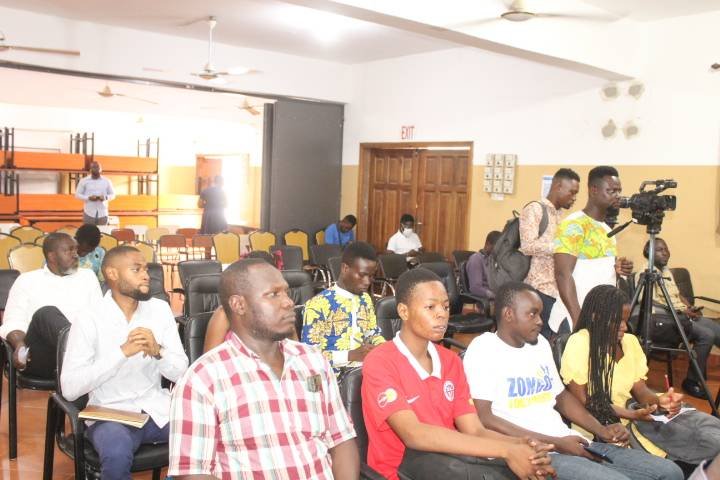
Addressing a press conference in Accra following his company’s victory at the TAIDO African Animation Awards in Japan, Mr. Brown positioned animation as a strategic economic lever rather than a cultural afterthought.
“Animation is no longer a niche segment. All developed economies that are thriving have had art as a backbone. It is now one of the fastest-growing sectors in the global creative economy,” he said.
Ghanaian talent won three awards out of six presented at the TAIDO African Animation Awards in Tokyo.
Mr. Brown revealed Africa’s share of the animation market is already valued at US$15.7billion, which according to him presents an unprecedented opportunity that could contribute significantly to gross domestic product (GDP).
Mr. Brown therefore urged government to strengthen intellectual property protection, create opportunities for public-private partnerships and sign co-production treaties with other countries to deepen international collaboration and attract investment into the sector.
According to him, this will create the enabling environment required to unleash the country’s enormous creative potential and transform the industry from fragmented individual pursuits into a significant GDP contributor.
The global animation industry was valued at US$436billion in 2024 and is expected to reach US$480billion this year before accelerating toward the trillion-dollar mark over the next decade.
The broader media and entertainment industry is also projected to hit US$3.5trillion by 2029. This growth is fuelled by patronage surge in streaming platforms, video games, artificial intelligence and educational media.
However, Mr. Brown noted that despite Africa’s young population with 60 percent under 25 years and a rich repository of untold stories, only a fraction of its economic value remains on the continent.
He cited the country’s stable political environment, rich cultural heritage and growing digital economy, asserting that “Ghana can become the animation hub of West Africa”.
Mr. Brown cited Japan as a proof of concept: “Japan tirelessly built anime. And today, anime is worth over US$60billion in revenue. So I believe that partnering with Japan, we get to learn a lot from them. We also get to input our own efforts and build our own revenue systems”.
Even though Africa’s animation industry reached US$15.71billion in 2025 and is projected to grow by 8.2 percent annually (higher than global average) to US$31.93billion by 2034, Mr. Brown maintained that a chunk of this hard currency flows back into the pockets of producers who are far beyond the continent’s borders.
Therefore, he noted, his outfit is collaborating with Japan’s Arc & Beyond on the TAIDO project, aimed at connecting Japan, Ghana, and broader Africa through animation innovation, training and work placement in Japanese studios.
The Japanese Ambassador to Ghana, Hiroshi Yoshimoto, highlighted cultural connections that predate formal industry collaboration.
“Africa is home to a rich tradition of storytelling and countless young creators full of potential,” Yoshimoto said. “For example, Onyankopon – an important character in the popular Japanese series ‘Attack on Titan’ – is derived from the sky-god of Ghana.”
He noted that the partnership will help address structural gaps and build on existing creative talent.
“The TAIDO project aims at promoting African cultures and stories to the world while fostering the animation industry to create employment opportunities locally,” he added.
Speaking at the press conference, Executive Secretary-Creative Arts Agency (CAA) Gideon Nii Aryeequaye acknowledged the glaring disparity between industry’s current reality and potential. He however expressed optimism about the sector’s future.
He said creative arts will be reintroduced into education curricula – noting that subjects like art and music which have been relegated to the background must be reintroduced.
“We cannot afford to do that. A nation that has no identity does not exist,” he stated.
Mr. Aryeequaye emphasised a need for animation to be integrated into formal education from the primary level.
“From infantry to industry, we need to find a way in which we can make animation a mainstream educational thing – where kids can learn from kindergarten to universities, where they become professionals,” Mr. Brown concurred.
The post Calls intensity for strategic investment in creative sector: Following AnimaxFYB’s win at animation awards in Tokyo appeared first on The Business & Financial Times.
Read Full Story









Facebook
Twitter
Pinterest
Instagram
Google+
YouTube
LinkedIn
RSS