
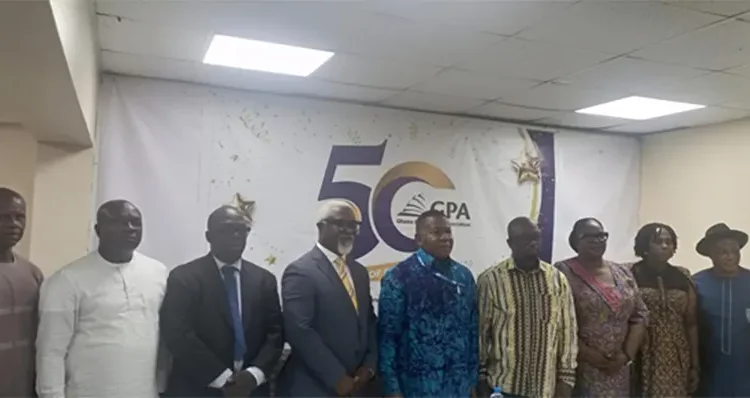

Edward Yaw Udzu, (4th L), Edmond Moukala (5th R) and officials in a group photograph
??President of Ghana Publishers Association (GPA), Edward Yaw Udzu, Esq., has stated that Ghanaian publishers have played a significant role in national development over the past five decades through their contributions to education, literacy and knowledge production.
??According to him, Ghanaian publishers have produced textbooks and other learning materials that support the educational system while also promoting Ghanaian literature and nurturing local authors.
??He said this during the Celebration of the 50th anniversary of the Ghana Publishers Association, themed, “50 Years of Indigenous Book Publishing: Our Stories, Our Future”.
??”The theme captures both the Ghanaian history and aspiration. The phrase “Our Stories” speaks to the importance of Ghanaians documenting and sharing their own experiences, cultures, histories, and ideas, and “Our Future” tells us that, the future of indigenous publishing must be innovative, resilient, and globally connected,” he added.
??Mr. Udzu, stressed that publishers have helped preserve indigenous languages through various publications and created employment opportunities across the book value chain, including authors, editors, printers, booksellers and librarians.
??”These efforts have helped build a vibrant ecosystem that supports education, literacy and knowledge development in the country,” he said.
??He underscored that, the Ghana Publishers Association has also played an important advocacy role by engaging government institutions, educational authorities and development partners to shape policies that strengthen the book industry and promote locally produced educational materials.
??Through initiatives such as book fairs, reading campaigns and partnerships with schools and libraries, he mentioned that, the association has contributed significantly to promoting a reading culture in the country.
??The GPA President noted that a strong publishing industry is not only a cultural asset but also a strategic national resource, stressing that no nation can build a knowledge economy without investing in books, literacy and knowledge production.
??”Technological change, shifting reading habits, piracy, and distribution challenges continue to affect the industry. Yet within these challenges lie opportunities for innovation and transformation,” he stressed.
??He mentioned that, the Ghana Publishing Association must adopt digital publishing platforms such as e-books and audiobooks to ensure that Ghanaian content remains accessible in an increasingly digital world.
??Also, he emphasised the need to support the next generation of writers, illustrators, editors and publishing professionals who will drive the industry forward, while strengthening copyright protection to safeguard the intellectual work of authors and publishers.
??He further urged efforts to expand the global reach of Ghanaian books so that local stories are not only read within the country but also shared with the wider international community.
??UNESCO Country Director, Edmond Moukala, commended the Ghana Publishers Association for its 50 years of resilience, noting that the association has served as a bridge between the wisdom of past generations and the aspirations of future generations.
??According to him, the book remains the most powerful tool for the dissemination of knowledge and the promotion of cultural identity.
??He noted that, to reclaim the African education system is to ensure that classrooms are populated with textbooks, literature, and reference materials that reflect the faces, the histories, and the values of children.
??”Indigenous publishing transforms education from a process of passive consumption into a journey of active self-discovery and national empowerment,” he said.
??Mr. Moukala explained that, language is more than a vehicle for communication; it is a repository of indigenous wisdom and a guardian of intangible heritage. Thus, UNESCO’s International Decade of Indigenous Languages underscores the urgent global need to protect and revitalise linguistic diversity.
??”By choosing to publish in Akan, Ewe, Ga, Dagbani, and other Ghanaian languages, publishers are ensuring that these ancestral tongues remain living vessels of modern thought,” he stated.
??Artificial Intelligence (AI), he said, can support translation, automated distribution, and help make literature accessible to people with visual impairments.
??Managing Director for Ghana Publishing Company, Nana Kwasi Boatey, congratulated the Ghana Publishers Association on its anniversary, emphasising the need for Ghanaians to tell their own stories while balancing dedication to the art of writing with commercialisation.
??He encouraged publishers to embrace digitalisation and modern platforms.
By Janet Odei Amponsah
Read Full Story







Facebook
Twitter
Pinterest
Instagram
Google+
YouTube
LinkedIn
RSS