


By Clement ADZISU
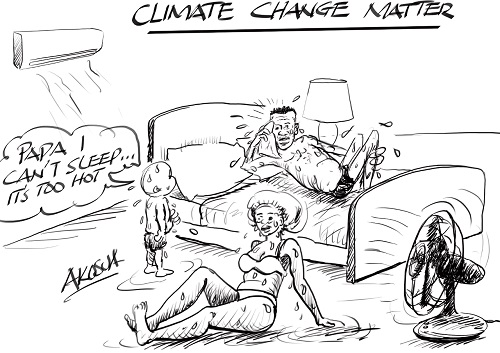
Climate risk needs to be managed in a way that builds on the responsible role that Ghana has assumed on the international platform regarding the challenge of climate change. However, while there is a focus on increasing ambition for mitigation, a critical gap remains in ensuring that this ambition is supported by a properly structured financial system.
Policy Momentum Without Financial Muscle
Ghana has made notable progress in articulating climate commitments over the past decade. From its Nationally Determined Contributions (NDCs) under the Paris Agreement to national energy transition and sustainability frameworks, the policy direction is clear. Yet beneath this momentum lies a critical gap. Climate policy has advanced far more rapidly than the financial systems required to implement it. Without a deliberate climate finance architecture, Ghana’s climate ambitions risk remaining aspirational rather than transformational.
When Climate Ambition Outruns Capital Markets
Globally, organized instruments such as green bonds, sustainability-linked loans, blended finance facilities, and carbon markets increasingly mediate climate finance. These platforms provide access to medium-term funding for renewable energy, climate-resilient infrastructural development, and low-carbon industrialization. In Ghana, domestic financial systems are still largely focused on short-term government papers and traditional loans. Financing for climate-related activities has not been integrated into domestic financial systems but is largely driven by external donor responses that are sporadic.
The Missing Financial Infrastructure
This is not a lack of intention but rather a lack of enabling financial infrastructure. Currently, there is neither depth nor liquidity in the green bond market in Ghana, although there is increasing demand in the international market for green assets. The regulatory incentives are not developed to encourage banks to factor climate risk considerations into their credit pricing and portfolio decisions. There are structural and regulatory barriers that hinder long-term investing in climate-convergent activities for funds that are institutional in nature, such as pensions and insurance schemes. There is also a shortage of financially viable green projects.
Why is climate finance a macroeconomic challenge?
The implications do not stop at the environmental level. Reports from the Ministry of Finance and the Bank of Ghana indicate that the domestic credit framework is now much more focused on government securities, while funding for infrastructure, clean energy sectors, and climate change adaptation remains very limited. Such a scenario is happening at a time when climate-induced shocks are gradually turning into fiscal stresses in terms of food and balance of payments. Climate finance is a macro-stability issue and not a marginal issue of sustainability.
Constructing the Architecture for Climate Finance in Ghana
What is needed is a comprehensive framework to systematically leverage and allocate capital to climate priorities. This includes regulatory support for green and sustainability-linked finance products, incentives for banks to accurately price climate exposures, and blended finance structures that attract private sector finance alongside development finance. On the encouraging side, Ghana has the beginnings but a sophisticated finance sector, a domestic bond market, and a developing fintech sector.
In conclusion, Climate ambition without finance is an unstable strategy. A rise in climate risks means that the economic cost of inaction will be felt in terms of fiscal crisis, disruption in production, and lower economic growth. The next level of Ghana’s leadership role in managing climate change needs to go beyond policy statements and be ready for the financial system. While policy on climate change can provide vision, it’s only financial architecture that will provide action.
The post Climate policy is not enough: Why Ghana needs climate finance architecture appeared first on The Business & Financial Times.
Read Full Story




Facebook
Twitter
Pinterest
Instagram
Google+
YouTube
LinkedIn
RSS