


There is something deeply dishonest about how we judge welfare and progress. We are quick in turning to esoteric economic metrics; the GDPs, the inflations, exchange rates tables and, occasionally, Human Development Index (HDI).
But hasn’t the greatest measure been how it treats it most vulnerable; its ‘lowly’? And in Ghana today, the ‘lowly’ are not a marginal minority. They are the vast majority.
They are the backbone. They are the workers who wake at 4 a.m. to earn wages that inflation has already consumed before payday arrives. They are the children packed into buses before sunrise, learning patience and pain long before algebra. They are nurses, clerks, traders, artisan – citizens whose daily lives are shaped, constrained and sometimes endangered by a transportation system that has ceased to be merely inefficient and become quietly cruel.
What does it say about us, that for millions of Ghanaians mobility has become a daily trial?
The transport crisis is not merely about congestion and delays. It is about dignity. It is about health. It is about safety. It is about time stolen, hours lost in traffic, productivity drained, family life eroded. It is about bodies worn down by stress, heat and exhaustion before the workday even begins.
Every wasted hour in traffic is lost productivity. Every missed appointment is foregone income. Every delayed delivery ripples through an already fragile economy. Yet this loss is treated as background noise that is too ordinary to provoke urgency, too familiar to shame those in charge
The crisis is also about danger. The buses popularly known as trotros are often death traps on wheels. Entirely not roadworthy, they are mobile contrapments of sharp exposed metal, splintering wood. As such, what should be a minor collision too often becomes a life-altering injury. An otherwise broken limb becomes a maimed leg. A routine commute becomes a permanent disability. Often, strictly speaking, these cannot be described as ‘accidents’. They are predictable outcomes of deliberate neglect.
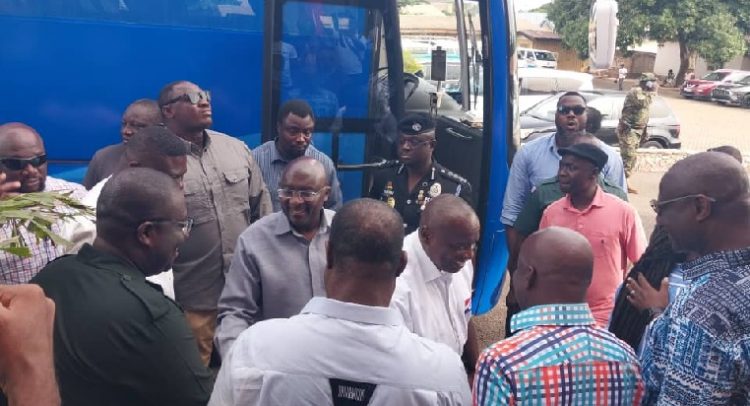
Every election season politicians theatrically board these buses, smiling for the cameras – momentarily “feeling the pain of the people”. Then the elections pass and the same politicians retreat behind tinted glass, sirens and motorcades. One is forced to ask, “if these buses are good enough for the governed, why are they not good enough for the governors?” Are they not “fellow Ghanaians”? Are they not our “brothers and sisters” as often proclaimed from podiums?
No one is asking for theatrics. What’s being demanded is responsibility. The Transport Ministry has a lot to answer for.
One hesitates to descend into the gutter with cheap personal criticism, but silence is not neutrality when commuters suffer daily.
Then there are the transport unions – powerful, unaccountable and increasingly indistinguishable from cartels. They decide when vehicles run, when they do not and how scarcity is manufactured. But even here, blame must travel upward. Cartels do not thrive in strong systems. They flourish where regulation is weak and enforcement selective. As for the state-owned transport entities, the least said about them the better.
Much noise is made about reckless drivers and unqualified operators – and rightly so. People die daily on Ghana’s roads. But blaming drivers alone is convenient cowardice. Who licences them? The Driver and Vehicle Licencing Authority. Who sets and enforces standards? The Transport Ministry. And who holds ultimate authority over all? The President, no?
Authority defines responsibility. To the extent each institution (and individual) has power, to that extent it bears guilt.
This is not a call for resignation as ritual. It is a call for seriousness. A call for the President to recognise that transportation is not a peripheral inconvenience but a central economic and social issue. A nation cannot work if it cannot move. A people cannot thrive if their daily journey to survival is unsafe, humiliating and exhausting.
How many hours must be wasted before urgency appears? How many injuries before reform stops being promised and starts being delivered? How many children must grow accustomed to discomfort before leadership feels discomfort of its own?
A country is seen clearly through its bus windows. And what Ghana sees today should trouble every conscience that claims to govern in its name.
The post Editorial: A nation seen through its bus windows appeared first on The Business & Financial Times.
Read Full Story


Facebook
Twitter
Pinterest
Instagram
Google+
YouTube
LinkedIn
RSS