
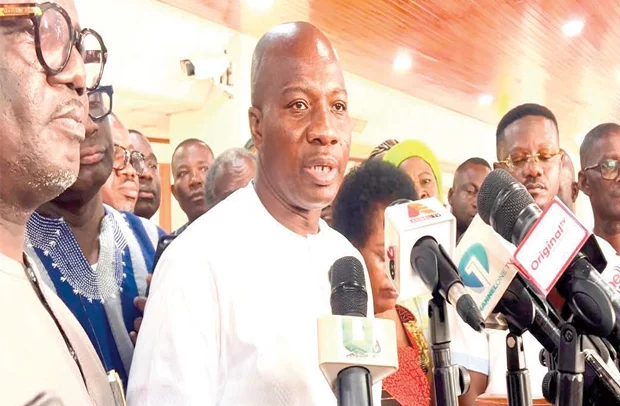

Members of the Majority caucus, led by Mahama Ayariga, addressing the media
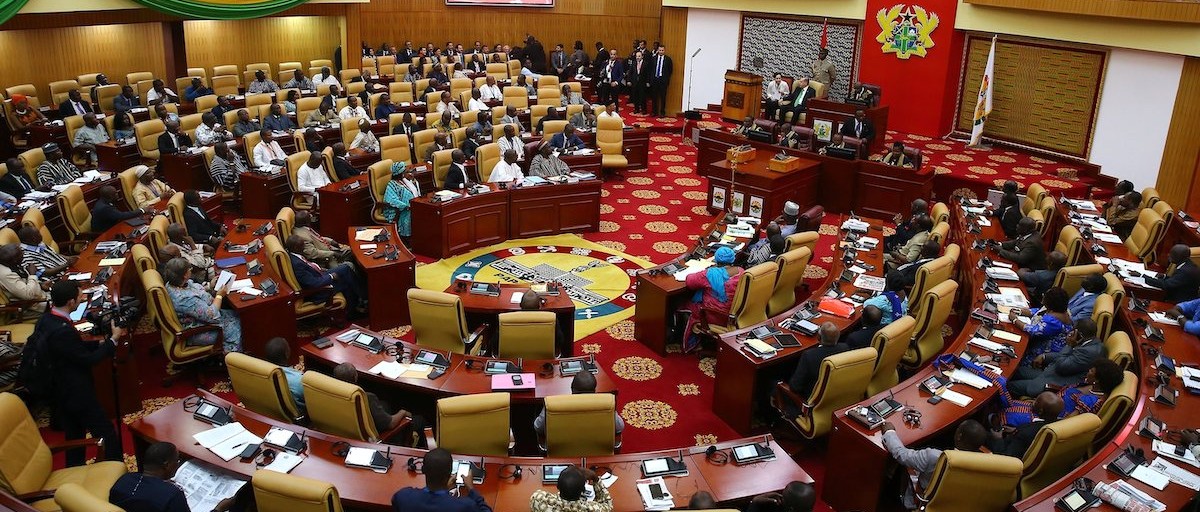
Parliament yesterday passed the 24-Hour Economy Authority Bill, clearing the legal path for the formal implementation of the National Democratic Congress (NDC) government’s flagship policy aimed at expanding job opportunities and transforming the economy into a round-the-clock production system.
Addressing the media after the passage of the bill, Majority Leader and Leader of Government Business, Mahama Ayariga, described the approval as a moment of “great joy” for the NDC, noting that the policy formed a central pillar of the party’s 2024 election promise to tackle unemployment and revitalise the economy.
“We, the members of the National Democratic Congress in Parliament, are happy to announce to the world that we have just passed the 24-Hour Economy Authority Bill,” Mr. Ayariga said.
“You will recall that the promise to transform the economy so that it becomes a major employer, providing jobs and livelihoods for the millions of youth who voted for the NDC, was partly hinged on the implementation of the 24-Hour Economy model,” he added.
He explained that the concept of a 24-Hour Economy is built around continuous economic activity, which would require businesses and industries to operate in multiple shifts across day and night.
According to him, such a system would naturally increase labour demand and create opportunities for both skilled and unskilled workers.
“If the country is working 24 hours, it will mean that we need more labour,” he said, and continued, “There will be several shifts – daytime shifts and nighttime shifts. The idea behind it is to create jobs and opportunities for our beautiful population, many of whom have graduated from universities.”
Mr. Ayariga linked the urgency of the policy to what he described as severe job losses and economic decline over the past eight years, attributing the situation to high taxation, financial instability, inflation and currency volatility.
These challenges, he said, forced several factories and businesses to shut down or relocate to other countries, leading to widespread unemployment.
He also recalled the impact of the financial sector clean-up, which resulted in the collapse of several financial institutions and the loss of hundreds of thousands of jobs, both directly and indirectly.
According to him, the NDC assumed office against the backdrop of what he termed an “economic mess,” making unemployment one of the most pressing issues facing the government.
“The National Democratic Congress admits that we have a problem of unemployment. Indeed, it is the reason why we were voted to take over the mantle of leadership of this country,” he said.
The Majority Leader outlined steps already taken by the government to stabilise the economy and lay the foundation for job creation.
These, he noted, include addressing fiscal challenges and injecting significant capital into state-owned financial institutions such as the Agricultural Development Bank (ADB) and the National Investment Bank (NIB).
“All the government banks have received major capital injection, running into billions of Ghana cedis. This is to breathe life back into the financial system so that these institutions can make money available to the private sector,” he intimated.
Mr. Ayariga stressed that for the 24-Hour Economy to be successfully implemented, there was the need for a dedicated authority with a clear legal mandate to coordinate policies, strategies and programmes across sectors.
He explained that the country’s constitutional framework requires such powers to be exercised strictly within the bounds of the law, making the passage of the bill essential.
“That is why, for us, it is a matter of great joy that ultimately, this Parliament has passed the 24-Hour Economy Authority Bill. It provides the regulatory regime and the legal mandate for the formalisation and implementation of the 24-Hour Economy,” he said.
He announced that with the bill now approved, the legal, regulatory and administrative structures are in place for the policy to take off fully.
By Ernest Kofi Adu, Parliament House
Read Full Story






Facebook
Twitter
Pinterest
Instagram
Google+
YouTube
LinkedIn
RSS