
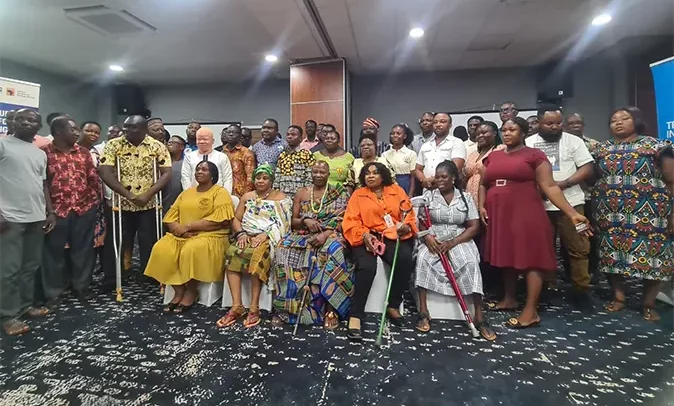

Participants in a group photograph after the workshop
A broad coalition of civil society organisations (CSOs), trade unions, pressure groups, traditional and religious leaders, political parties, youth and student representatives, development partners and the media have been urged to move beyond rhetoric and take decisive, practical steps to confront corruption head-on in Ghana.
The call was made at a high-level stakeholders’ engagement organised by Transparency International-Ghana under its Anti-Corruption Initiative for Enhancing Governance and Accountability.
The meeting brought together key national actors to deliberate on collective strategies aimed at strengthening Ghana’s national integrity system and promoting accountable governance.
Francis Asong, Executive Director and former Board Member of Transparency International Ghana, underscored the urgency of building a united national front against corruption. He warned that corruption continues to undermine development by weakening state institutions, distorting public policy, compromising service delivery, as well as eroding public trust in leadership and governance structures.
According to Mr. Asong, the persistence of corrupt practices across sectors demands sustained and coordinated action that goes beyond public pronouncements. He stressed that anti-corruption efforts must translate into measurable reforms, institutional accountability and active citizen participation if meaningful progress is to be achieved.
Mr. Asong disclosed that the engagement received support from the Foreign Commonwealth and Development office in collaboration with the Ghana Anti-Corruption Coalition and the African Centre for Energy Policy.
He noted that the involvement of both international development partners and local organisations reflects a shared commitment to strengthening democratic governance in Ghana.
He stated that addressing corruption and governance challenges requires a blend of global expertise and local knowledge. While external partners provide financial support, technical assistance and comparative experience, domestic institutions ensure contextual relevance, grassroots mobilisation and sustainability of reform initiatives.
Mr. Asong further emphasised that collaborative governance initiatives create platforms for dialogue, shared learning and collective action, thereby enhancing the effectiveness of anti-corruption interventions. Such partnerships, he indicated, not only strengthen institutional capacity but also reinforce public confidence in reform processes.
He stressed that the fight against corruption cannot be left to government alone but must be embraced as a national responsibility requiring organised civic action and institutional reform.
FROM Daniel K. Orlando, Ho
Read Full Story





Facebook
Twitter
Pinterest
Instagram
Google+
YouTube
LinkedIn
RSS