


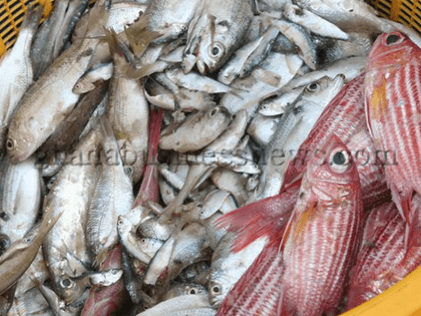
The country’s average per capita fish consumption is reckoned at 23 kilogrammes per annum and fish demand will outstrip supply until 2023, thus making the country a net importer of fish.
This is in spite of the fact that fish imports serve as a potential revenue source for government since there is a mandatory 15% import tax on seafood imported into the country.
The country’s highest export of fish was in 2011, when it exported 44,114.82 metric tonnes of fish with a value of US$254 million.
Ghana exports several kinds of fish products: fresh, frozen and canned mainly to the United Kingdom, Spain, Portugal, Italy and France. Canned tuna constitutes by far the biggest export.
This was made known at a United Nations Industrial Development Organisation (UNIDO) Trade Capacity Building Programme for Ghana, and a fish value chain validation workshop this week.
The workshop discussed findings of the assessment of the fish value chain with a view to identifying key challenges of selected fish products and draw up activities that add value to the industry for easy access to local and international markets.
The assessment concentrated on three fish chains -- tuna, tilapia and smoked inland fish. Along the tuna fish chain, the final national market consumes 22,000 metric tonnes a year while 61,000 metric tonnes is exported to Europe.
The potential processing capacity for the country is reckoned at 120,000 metric tonnes a year against 61,000 metric tonnes a year, which is the current capacity. The value of catches is 91 million euros and direct value added by processing is 44 million euros.
For tilapia on the other hand, there is no export of tilapia since internal demand for the product is high -- though small quantities of salted tilapia (koobi) are exported. However, feed has been identified as a major challenge for aquaculture while fish-seed is another challenge for the sub-sector.
As stated, currently there is no industrial processing of tilapia though the potential exists for processing skinless, boneless tilapia for European and American markets.
With regard to inland smoked fish, it has been recommended that the processing industry must be regulated to ensure low levels of PAH, a chemical residue, to enable it enter into the European market.
Currently, the requirement is less than 5 ppb, but the regulation will be further reduced to 2ppb after September 1 since the Ghana Standard Authority (GSA) doesn’t have all the equipment. Processed fish is reckoned at 14.6 metric tonnes a year and the major exporting countries are Germany, Belgium and the United Kingdom.
The GSA has accredited laboratories, and this has been described as a huge step forward since samples can be sent all over Europe for verification. GSA is currently enlarging its scope of accreditation as it wishes to be up to the organic certification of fruits and vegetables, a growing concern among health-conscious Europeans.
The UNIDO project was set up in 2007 and is funded by the Swiss Confederation through the State Secretariat for Economic Affairs (SECO), and the objective is to enhance the country’s export performance.
By Konrad Kodjo Djaisi







Facebook
Twitter
Pinterest
Instagram
Google+
YouTube
LinkedIn
RSS