
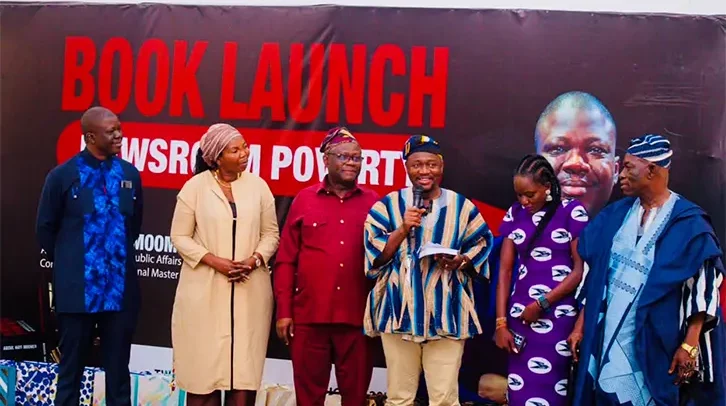

Abdul Hayi Moomen with Alhassan Suhuyini, Prof. Amin Alhassan and other dignitaries at the launch
Director of Public Affairs at the University for Development Studies (UDS), Abdul Hayi Moomen, has launched a book titled “Newsroom Poverty: The Silent Crisis in Ghanaian Journalism” in Tamale, Northern Region.
The launch attracted dignitaries including Member of Parliament for Tamale North and Deputy Minister for Roads and Highways, Alhassan Suhuyini, Director-General of the Ghana Broadcasting Corporation (GBC), Professor Amin Alhassan, UDS management, representatives of civil society organisations (CSOs) and other personalities.
Addressing participants at the launch, Mr. Moomen said the book is not meant to embarrass journalists but to expose the conditions under which many of them work.
“This book is not an attack on journalists. It is an act of love for journalism. It is not intended to embarrass journalists. It is intended to embarrass the conditions under which many journalists are compelled to work,” he said.
He stressed that journalists perform essential public functions: informing society, exposing wrongdoing, holding power to account, defending the vulnerable and giving voice to the voiceless, but many face serious private financial struggles behind the confident voices on radio, polished faces on television and impressive bylines.
“We used to joke that our take home pay could not take us home. We laughed, but the joke was painful because it was true. The salary would arrive, and transport, rent, food, school fees and family responsibilities would already be waiting. Before the month had properly begun, the salary had finished. Yet the journalist was still expected to dress well, travel, remain objective, resist pressure, reject inducements and perform with courage and professionalism. Society demands the highest ethical standards from journalists—and rightly so—but society must also ask whether journalists are being given the conditions that make those standards easier to uphold,” he said.
Mr. Moomen noted that journalists sometimes depend on ‘soli’, a practice that can undermine their dignity and independence.
“The real problem is not merely the envelope. The deeper problem is the system that makes the envelope necessary. Soli can undermine the dignity and independence of journalists. It creates the impression that journalists must be financially motivated before they can perform their professional duty. A properly resourced media organisation should transport its journalists, provide the tools they need and pay them fairly. Journalists should not have to depend on the people they cover in order to cover them, and here is one of the greatest ironies of our profession: journalists speak for everybody except themselves. When teachers are unhappy, journalists report it. When nurses are dissatisfied, journalists give them airtime. When workers are underpaid, journalists tell their stories. When communities need roads, water, schools or hospitals, journalists amplify their voices. But when journalists are poorly paid, denied contracts, denied social security, overworked or exposed to unsafe conditions, who tells their story?” he asked.
Mr. Moomen urged media owners to improve on the working conditions of journalists, and called on policymakers to recognise journalism as a public good.
“I do not pretend that one book will solve every problem. A book cannot pay salaries, provide insurance, fuel news vehicles or replace broken equipment. But a book can begin a conversation. It can document what has been ignored. It can give language to experiences people have struggled to explain. It can make silence uncomfortable. Sometimes change begins when silence is broken. My hope is that this book will encourage media owners to reflect on working conditions; policymakers to recognise journalism as a public good; professional bodies to speak more firmly about salaries, contracts, welfare and safety; and journalists themselves to understand that asking for fair treatment is not an act of disloyalty to the profession.”
He dedicated the book to journalists across the country and beyond who love the profession but are uncertain about their future.
“To my fellow journalists: this book is for you. It is for the young reporter who loves the profession but is uncertain about the future. It is for the experienced journalist who has served society faithfully but has little financial security to show for it. It is for those who have remained silent because they feared that speaking would make them appear ungrateful. You are not ungrateful. You are asking for dignity. You are asking for fairness. You are asking for a profession that rewards the enormous responsibility it places on your shoulders,” he said.
FROM Eric Kombat, Tamale
Read Full Story







-1200x902.webp)


.jpg)
Facebook
Twitter
Pinterest
Instagram
Google+
YouTube
LinkedIn
RSS