


The Member of Parliament for Karaga, Dr. Mohammed Amin Adam, has called for careful policy attention, following the release of the Bank of Ghana’s audited 2025 financial statements, noting that certain trends could have implications for Ghana’s fiscal outlook and post-programme economic management.
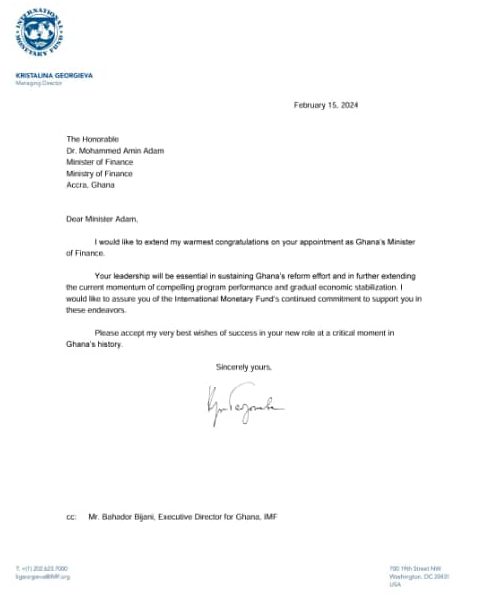
In a communication to the International Monetary Fund (IMF) Mission Chief, Dr. Amin Adam acknowledged the progress made under Ghana’s Extended Credit Facility (ECF) programme, particularly in stabilising inflation and strengthening external reserves.
However, he emphasised the importance of safeguarding these gains as the country transitions into a post-programme phase.
A key issue raised relates to the Bank of Ghana’s balance sheet position. The central bank’s negative equity widened from GH¢61.32 billion in 2024 to GH¢96.28 billion in 2025.
While this reflects the lingering effects of recent economic shocks and policy interventions, the MP noted that it may require a structured and transparent recapitalisation plan over the medium term.
“Even if addressed gradually, this remains an important consideration for fiscal planning,” he indicated, pointing to the need for clarity on the scale, timing and financing approach for any recapitalisation efforts.
Operating Costs and Financial Performance
The central bank’s financial results also show an increase in losses, from GH¢9.49 billion in 2024 to GH¢15.63 billion in 2025, despite growth in operating income.
This development, Dr. Amin Adam explained, appears to be driven largely by higher costs associated with monetary policy operations, including liquidity management and exchange rate-related adjustments.
In particular, the cost of Open Market Operations (OMO), a key instrument for managing inflation, rose to GH¢16.73 billion in 2025, up from GH¢8.60 billion the previous year.
While such costs are often part of efforts to stabilise prices, he noted that their scale warrants ongoing monitoring to ensure sustainability.
The MP also drew attention to the role of gold-related transactions in shaping the Bank’s financial position. The accounts show a significant gain from refined gold sales, which contributed to a reported positive policy solvency position.
However, he suggested that distinguishing between recurring operational income and one-off gains could provide a clearer picture of the Bank’s underlying financial strength. He also encouraged enhanced disclosure around gold transactions to improve transparency and public understanding of their economic impact.
Another area highlighted is the movement in the Bank’s revaluation reserves, which declined sharply in 2025 due to exchange rate and asset valuation changes. While such adjustments are consistent with international accounting standards, they underscore the sensitivity of the Bank’s balance sheet to market conditions.
Broader Fiscal Considerations
Dr Amin Adam further noted that developments within the central bank have broader implications for fiscal policy.
He explained that potential recapitalisation requirements, together with other financial sector obligations, should be factored into medium-term fiscal planning.
This, he said, would help ensure that sufficient fiscal space is preserved for priority areas such as infrastructure, healthcare, and education.
He also emphasised the importance of viewing fiscal performance in a broader context beyond the central government budget to include central bank operations and other contingent liabilities.
To support long-term stability, the MP proposed a number of policy considerations, including the development of a transparent recapitalisation framework for the Bank of Ghana, enhanced reporting of quasi-fiscal operations, and the publication of a clearer measure of policy solvency that excludes one-off items.
He also encouraged continued adherence to safeguards that limit monetary financing of government expenditure, as well as ongoing engagement with international partners to strengthen policy credibility.
Dr. Amin Adam concluded by reaffirming the importance of maintaining policy discipline as Ghana exits the IMF programme. While acknowledging the progress achieved in recent years, he stressed that careful management of emerging risks would be key to sustaining macroeconomic stability and supporting inclusive growth.
The observations come at a time when Ghana is preparing for its next phase of economic management, with policymakers seeking to consolidate recent gains while navigating a complex global and domestic environment.
For more news, join The Chronicle Newspaper channel on WhatsApp: https://whatsapp.com/channel/0029VbBSs55E50UqNPvSOm2z
The post Amin Adam: BoG’s 2025 Accounts Signal Fiscal Pressures appeared first on The Ghanaian Chronicle.
Read Full Story





Facebook
Twitter
Pinterest
Instagram
Google+
YouTube
LinkedIn
RSS