


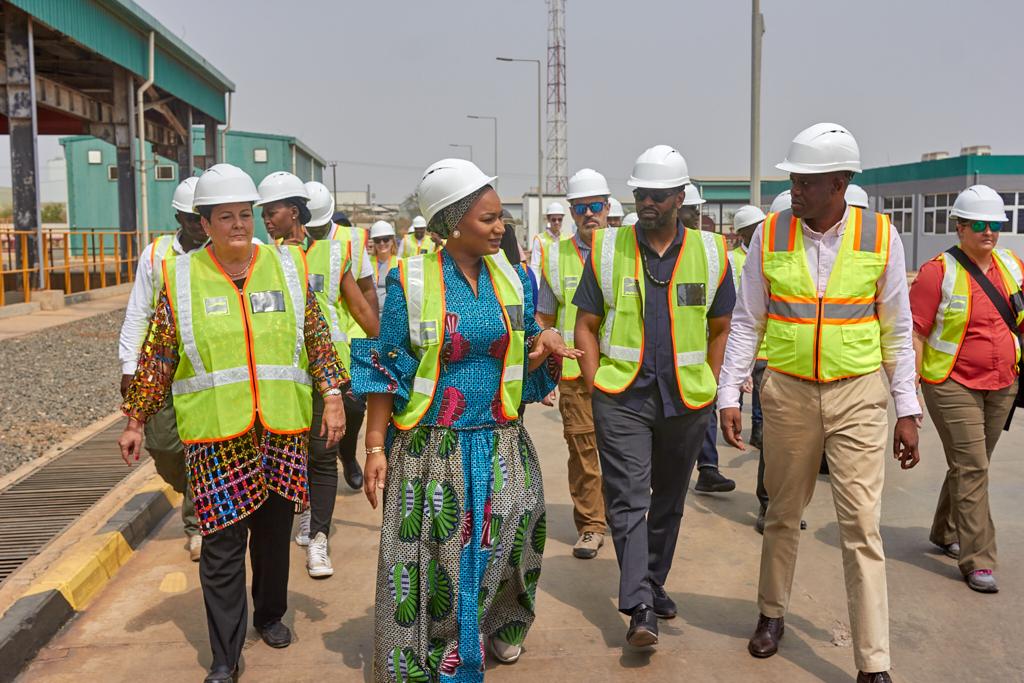
A group of Civil Society Organizations (CSOs) has toured the Ghana National Gas Company (GNGC) as part of efforts by the state-owned firm to strengthen transparency and deepen engagement with key opinion leaders in the energy sector.
The tour, which took participants through the Gas Processing Plant (GPP) and other critical installations, formed part of Ghana Gas’ 2025–2026 corporate strategy to build stronger relationships with stakeholders and shape informed national discourse on the country’s gas infrastructure.
Head of Corporate Affairs at Ghana Gas, Richard Ernest Kirk Mensah, speaking in an interview with the media said the initiative was the first structured engagement with CSOs since the inception of the company in 2014.
“For the first time since this administration took office, we met civil society groups in Accra for extensive deliberations on the operations and management of the company. We promised to bring them to the site for firsthand insight, and that is why we are here today,” he explained.
According to him, many Ghanaians form opinions about Ghana Gas without fully understanding its operations.
“People may sit in Accra and have a fair idea of how Ghana Gas operates, but when they come here and see how gas is received, processed and supplied to off-takers, their narratives will definitely change. CSOs shape opinions and lead conversations in the national discourse, so it is important they understand what we do,” he said.
He noted that beyond the plant visit, management would hold further deliberations with the CSOs to align expectations and discuss the company’s short- and medium-term goals.
Major Projects in the Pipeline
On the company’s strategic priorities, Mr Kirk Mensah disclosed that three major projects were high on the agenda of the Chief Executive Officer, Judith Blay, and management: the second Gas Processing Plant (GPP2), a new onshore transmission pipeline from Takoradi to Tema, and a third compressor station.
“The President has made an emphatic statement that we are going to build GPP2. The technical committee from Finance and Energy has completed its work, and we are awaiting Cabinet directive to commence construction,” he said.
He explained that the proposed Takoradi–Tema onshore pipeline would be wholly owned by Ghana Gas and designed to allow off-takers in various regions to tap gas directly for industrialization.
“It is a major project the board and management are keen to start as soon as possible. The third compressor station will also optimize gas production and improve efficiency,” he added.
Mr Kirk Mensah maintained that the selection of CSOs for the tour was merit-based and part of the company’s open-door policy.
“We do not have preferred CSOs. Invitations were sent widely, and those who could make it joined. Our doors remain open,” he said.
‘A Game Changer’
Speaking to the media after the tour, Executive Director of the Chamber of Petroleum Consumers Ghana (COPEC), Duncan Amoah, described Ghana Gas’ operations as a transformative development for the country’s energy security.
“Years ago, when Ghana struck oil, we did not immediately see the need for a gas processor. For some time, even after production began, we were still importing gas from Nigeria through the West African Gas Pipeline. At times when debts accumulated, the valve could simply be turned off,” he recalled.
Today, he said, the narrative has changed. “Ghana is now processing its own gas, feeding thermal plants and keeping them running. Even though the power sector owes Ghana Gas significantly, they do not turn off the valve. That alone has enhanced our energy security,” he stated.
Mr Duncan Amoah added that Ghana Gas now supplies about 50 per cent of the country’s Liquefied Petroleum Gas (LPG) demand, a significant shift from the period when Ghana imported 100 per cent of its LPG needs.“If you put these together strategically, it is a game changer,” he stressed.
Call for GGP 2
However, he warned that delays in expanding processing capacity could cost the nation financially.
He urged government to expedite work on the second gas processing plant, commonly referred to as “Train 2,” which is expected to process an additional 200 million standard cubic feet of gas per day.
“If we are able to complete Train 2 within the next 12 to 24 months, chances are we could meet 100 per cent of our LPG demand without imports.
“The longer we delay, we are simply throwing away money importing from Europe, Dubai and elsewhere,” he argued.
According to him, increased capacity would not only stabilize thermal power generation, but also position Ghana to export gas to the sub-region
.“As it stands, we are losing money,” he emphasised.
Gas as a Transition Fuel
Touching on global energy transition conversations, Mr Amoah described natural gas as a cleaner and necessary bridge in the shift away from heavier fossil fuels.“Gas is a transition product. It is cleaner and healthier compared to other fuels.
Even as we move towards renewables, gas will still play a critical role in powering many sectors,” he noted, citing the difference between LPG use in homes and charcoal as an example of its environmental benefits.
He also commended Ghana Gas for the localization of technical expertise at the plant.
“The engineers you see here are Ghanaians. Technology transfer has happened. This plant is manned by Ghanaian engineers who have stabilized operations and are doing a wonderful job. It shows that the Ghanaian is capable,” he said.
For more news, join The Chronicle Newspaper channel on WhatsApp: https://whatsapp.com/channel/0029VbBSs55E50UqNPvSOm2z
The post Ghana Gas Woos Civil Society, Pushes for ‘Train 2’ to Boost Energy Security appeared first on The Ghanaian Chronicle.
Read Full Story



Facebook
Twitter
Pinterest
Instagram
Google+
YouTube
LinkedIn
RSS