
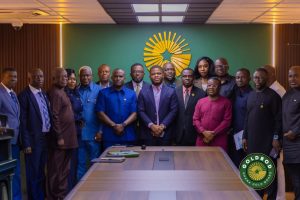

The Parliamentary Select Committee on Economy and Development has conducted a working visit to the Ghana Gold Board (GoldBod) to evaluate the institution’s operations, achievements and strategic direction, as Ghana seeks to maximise the economic value of its gold resources.
The visit formed part of Parliament’s oversight responsibility to assess GoldBod’s contribution to the national economy, particularly in gold trading, foreign exchange mobilisation, reserve accumulation and value addition.
 Chairman of the Committee, Eric Afful, said the engagement was intended to provide lawmakers with firsthand insight into GoldBod’s performance and its role in supporting Ghana’s economic recovery through the effective management of the country’s gold resources. He noted that the Committee was particularly interested in understanding how GoldBod is strengthening the gold value chain, increasing foreign exchange inflows and ensuring that the country derives greater value from its mineral wealth.
GoldBod Highlights Reforms Welcoming the delegation, the Chief Executive Officer of GoldBod, Sammy Gyamfi, presented a detailed overview of the institution’s transformation from the former Precious Minerals Marketing Company (PMMC) into the Ghana Gold Board.
He outlined the Board’s licensing regime, funding model and the ongoing review of the Ghana Gold Board Act, 2025 (Act 1140), as well as initiatives aimed at promoting responsible mining, enhancing gold traceability and increasing local value addition.
Mr Gyamfi also briefed the Committee on GoldBod’s partnerships with large-scale mining companies, the Board’s gold aggregation performance in 2025 and 2026 and its new trading model designed to improve efficiency, transparency and accountability within Ghana’s gold export industry. In a major development, he announced that GoldBod would procure a comprehensive gold traceability system by the end of August 2026.
The digital system will enable the Board to track every ounce of gold purchased from licensed mine sites through the entire supply chain to export.According to him, the initiative is expected to strengthen accountability, boost confidence in Ghana’s gold exports and significantly curb illegal gold trading and smuggling. 54 Metric Tonnes Purchased in Six Months Gyamfi disclosed that GoldBod purchased 54 metric tonnes of gold from the artisanal and small-scale mining (ASM) sector during the first half of 2026, placing the country on course to match or even surpass its record performance from the previous year.
The figures further underscore the growing dominance of the ASM sector in Ghana’s gold industry and reaffirm gold’s position as the country’s leading source of foreign exchange earnings.
The impressive performance follows an exceptional 2025, when GoldBod purchased and exported 104 metric tonnes of gold from the ASM sector—the first time production from small-scale miners exceeded that of Ghana’s large-scale mining companies.
The ASM sector generated nearly US$11 billion in foreign exchange earnings in 2025, outperforming the approximately US$9 billion contributed by large-scale mining firms.
The Board said the trend reflects the increasing importance of artisanal and small-scale mining to Ghana’s economy, with the sector emerging as the country’s largest contributor to export revenue.US$16.11 Billion Gold Transactions GoldBod further revealed that it purchased and exported gold worth US$16.11 billion between January 2025 and May 2026.
During the period, the Board acquired 135.843 metric tonnes of gold, of which 135.221 metric tonnes originated from the artisanal and small-scale mining sector, accounting for virtually the entire volume. According to the Board, the performance demonstrates the success of reforms aimed at formalising the small-scale mining sector, reducing illegal gold trading and increasing official gold purchases.
These reforms, it explained, have channelled significantly more gold through formal marketing systems, enabling the state to capture greater export revenues while strengthening Ghana’s external reserves through increased dollar inflows.As part of efforts to regulate the gold trade, GoldBod announced that it had licensed 1,184 gold buyers as of May 31, 2026.The licensed operators comprise two aggregators, 67 self-financing aggregators, 736 Tier Two buyers and 379 Tier One buyers.Under the GoldBod framework, all licensed buyers are required to purchase gold exclusively from licensed miners before selling it to the Board for export.
The licensing regime forms part of broader measures to reduce smuggling, improve traceability and ensure that export proceeds flow through official channels to strengthen Ghana’s foreign exchange reserves.Gold Sector Supporting Economic Recovery GoldBod attributed the sector’s strong performance to reforms introduced to combat gold smuggling and improve the formal purchase of gold from artisanal miners. According to the Board, these measures have substantially increased the volume of gold traded through official channels, allowing Ghana to derive greater economic benefit from its largest export commodity.
Although GoldBod’s original projections for 2026 were based on an average gold price of about US$5,000 per ounce and weekly purchases of approximately 2.5 metric tonnes, the Board indicated that current gold prices, while lower than earlier assumptions, remain above 2025 levels.
As a result, Ghana is still expected to record higher gold export earnings in 2026 than it did in the previous year, although revenues may fall short of the Board’s initial projections because of fluctuations in international gold prices.With artisanal and small-scale mining continuing to outperform the large-scale mining sector, GoldBod expects gold to remain a major pillar of Ghana’s foreign exchange earnings and economic recovery throughout 2026.
Supporting Ghana’s Reserve Accumulation ProgrammeGoldBod’s expanding role is also expected to advance the government’s Ghana Accelerated National Reserve Accumulation Programme (GANRAP), which aims to increase Ghana’s foreign reserves to the equivalent of 15 months of import cover by the end of 2028.
Current estimates place Ghana’s import cover at approximately 5.7 months, leaving a gap of about 9.3 months to meet the target.
Government estimates indicate that achieving this objective will require an average annual net reserve build-up of about US$9.5 billion, after accounting for external debt servicing, foreign exchange interventions, energy sector obligations and other statutory payments. As part of the programme, the government has set a weekly gold purchase target of approximately 3.02 metric tonnes, which officials estimate could generate annual gross inflows of about US$25.3 billion.
According to GoldBod, these inflows would significantly strengthen Ghana’s reserve position, support exchange rate stability and enhance long-term macroeconomic resilience.
For more news, join The Chronicle Newspaper channel on WhatsApp:
https://whatsapp.com/channel/0029VbBSs55E50UqNPvSOm2z
The post GoldBod To Procure A Gold Traceability System Next Month -Sammy Gyamfi appeared first on The Ghanaian Chronicle.
Read Full Story


Facebook
Twitter
Pinterest
Instagram
Google+
YouTube
LinkedIn
RSS